Advanced Mold Texturing Process & Mold Etching Technology
Yuan Su Mold Texturing LTD is a leading expert in mold etching process in China. We provide professional mould texture services and high-quality plaques for global customers. Contact us for cost-effective solutions for your design inquiries.
Mold etching refers specifically to the chemical corrosion methods used to imprint a pattern into a mold cavity, as distinct from mechanical texturing such as sandblasting or laser ablation. Methods #2 (Etching Texture) and #3 (VDI 3400 / EDM Finish) below are our two core mold etching processes, both controlled to a depth tolerance of ±0.01mm using a calibrated depth gauge rather than visual comparison.
Our Specialized Texturing Technologies
1. Sandblasting
Using sandblasting machines to achieve a matt effect and adjust surface gloss through precision fine sand media.
Applies to: High-precision electronics (Printers, Cameras, etc.).
2. Etching Texture
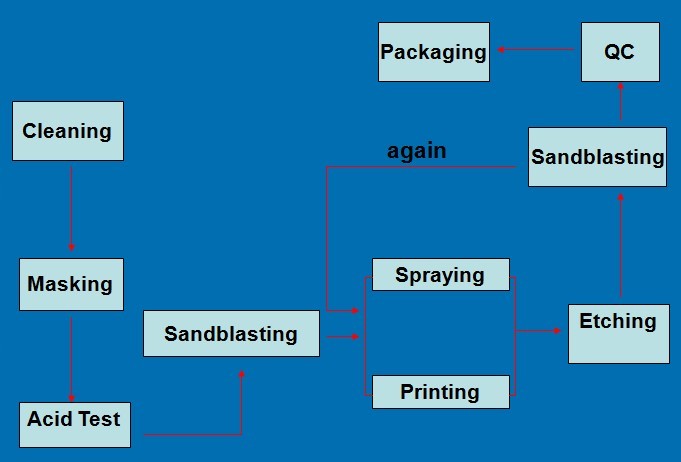
A specialized mold etching process using ink-spray to define base patterns, followed by professional texturing cycles.
Applies to: Automobiles, Electronics, Appliances, and Furniture.
Etch depth is built in progressive stages — typically 2 to 3 spray-and-etch cycles — because a single pass produces a flat, uniform depth that reads as artificial next to natural leather or wood grain. Each cycle is verified against the target depth before the next mask is applied.
3. VDI 3400 / EDM Finish
Chemical mold texturing process to achieve VDI 3400, EDM texture, or EDM surface effects (Ref. No.18 to No.45).
Applies to: Laptop monitors, Printers, and precision tools.
| VDI Grade | Ra (µm) | Typical Appearance |
|---|---|---|
| VDI 18 | 0.80 | Satin finish |
| VDI 24 | 1.60 | Dull finish |
| VDI 30 | 3.15 | Dull finish, visible texture |
| VDI 36 | 6.30 | Coarse texture |
| VDI 42 | 12.50 | Heavy texture |
| VDI 45 | 18.00 | Roughest standard grade |
We calibrate laser and etch parameters against a profilometer reading, not visual comparison, keeping results within the accepted ±2 CH unit tolerance across the full cavity.
4. Hairline Texture
Custom hairline designs (beeline/interrupt line) with focus on depth and seamless jointing of superfine lines.
Applies to: Automotive CD panels, iPhone/iPad cases, and Laptops.
5. Leather Texture
Multilayer mold texturing process combining sandblast and spray to create stereoscopic leather patterns with precise seam jointing.
Applies to: Automotive interiors (Instrument panels, Door panels).
6. Geometric Texture
Focuses on regularity and surface friction to make products more stereoscopic and sensuous.
Applies to: Tool handles, Switches, and Handheld electronics.
The required draft angle for mold etching depends mainly on the pattern depth and structure complexity. Generally, for every 0.02mm of texture depth, an additional 1 degree of draft angle is required to ensure smooth plastic injection parts ejection without scratches or deformation.
For traditional chemical etching, pattern jointing relies on experienced craftsmen using precise film masking and multi-stage spray treatments. For high-precision automotive molds, we utilize advanced 5-axis laser texturing machines to completely eliminate physical seams via digital simulation.
Etching depth is set by acid concentration and immersion time rather than judged by eye. We verify each cycle with a depth gauge, holding a tolerance of ±0.01mm so multi-cavity molds etch consistently across every cavity.
For large, simple leather or wood-grain surfaces, chemical mold etching is more cost-effective since it needs no laser programming time. For parts with tight radii or gradient patterns, laser etching avoids the seam lines that can appear where chemical film masks meet on curved surfaces.